Anatomy of AI Governance & Risk
Policies, model cards, approvals, audit trails for regulated teams.
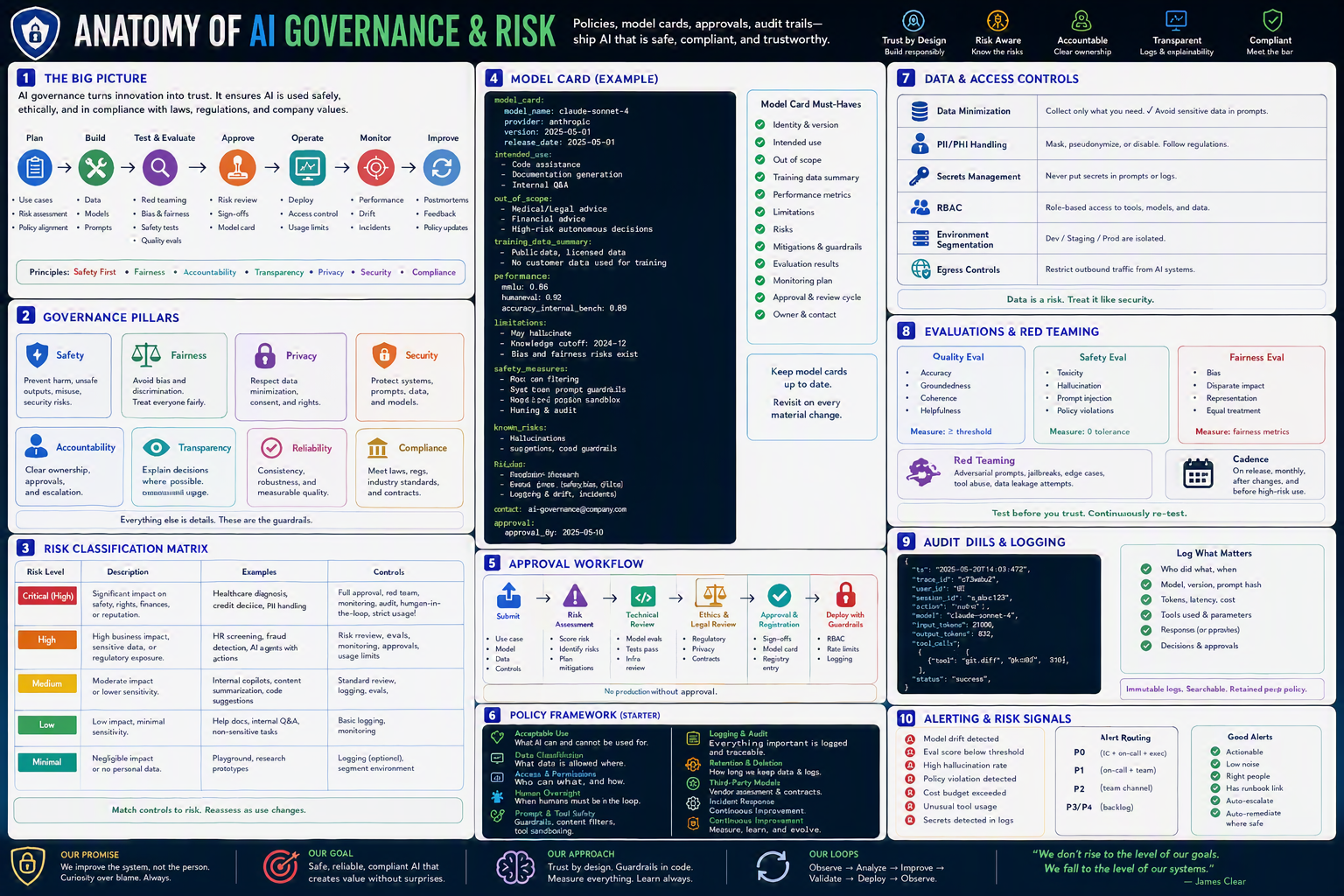
Policies, model cards, approvals, audit trails — how regulated teams ship AI that is safe, compliant, and trustworthy without slowing innovation to a crawl.
TL;DR
- AI governance turns innovation into trust: safe, ethical, lawful, and aligned with company values.
- Eight pillars: Safety · Fairness · Privacy · Security · Accountability · Transparency · Reliability · Compliance.
- Match controls to risk tier (Minimal → Critical). Don't over-govern low risk; never under-govern high risk.
- Every system has a model card, an approval trail, and an audit log.
- Trust by design. Guardrails live in code, not slide decks.
Why this matters
AI without governance is a liability waiting to happen — biased outputs, leaked PII, surprise costs, unexplained decisions, or a regulator at your door. Governance done well is the opposite of slow: it's the operating system that lets you ship AI faster because the safety, legal, and ethical questions have already been answered.
Bottom line: Safe, reliable, compliant AI creates value without surprises.
The Big Picture — Governance Lifecycle
Principles
- 🛡️ Safety first
- ⚖️ Fairness
- 🤝 Accountability
- 🪟 Transparency
- 🔒 Privacy
- 🧱 Security
- 📜 Compliance
Bottom line: Everything else is details. These are the guardrails.
Governance Pillars
| Pillar | What it ensures |
|---|---|
| 🛡️ Safety | Prevent harm, unsafe outputs, misuse, security risks |
| ⚖️ Fairness | Avoid bias and discrimination; treat everyone fairly |
| 🔐 Privacy | Respect data minimization, consent, and rights |
| 🔒 Security | Protect systems, prompts, data, and models |
| 🤝 Accountability | Clear ownership, approvals, and escalation |
| 👁️ Transparency | Explain decisions where possible — operationalized usage |
| ✅ Reliability | Consistency, robustness, and measurable quality |
| 📜 Compliance | Meet laws, regulations, industry standards, and contracts |
Risk Classification Matrix
Match controls to risk. Don't over-govern low risk; never under-govern high risk.
| Risk level | Description | Examples | Controls |
|---|---|---|---|
| 🔴 Critical (High) | Significant impact on safety, rights, finances, or reputation | Healthcare diagnosis, credit decisions, PII handling | Full approval, red team, monitoring, audit, human-in-the-loop, strict usage |
| 🟠 High | High business impact, sensitive data, regulatory exposure | HR screening, fraud detection, AI agents with actions | Risk review, evals, monitoring, approvals, usage limits |
| 🟡 Medium | Moderate impact or lower sensitivity | Internal copilots, content summarization, code suggestions | Standard review, logging, evals |
| 🟢 Low | Low impact, minimal sensitivity | Help docs, internal Q&A, non-sensitive tasks | Basic logging, monitoring |
| 🔵 Minimal | Negligible impact or no personal data | Playground, research prototypes | Logging (optional), segment environment |
💡 Tip: Match controls to risk. Re-assess as the use case changes. A copilot that "just summarizes" turns into a regulated system the moment it starts taking actions for users.
Model Card (example)
A model card is the fact sheet for any model or AI system. It travels with the system across teams, audits, and incidents.
model_card:
  model_name: claude-sonnet-4
  provider: anthropic
  version: 2025-05-01
  release_date: 2025-05-01

intended_use:
  - Code assistance
  - Documentation generation
  - Internal Q&A

out_of_scope:
  - Medical / legal advice
  - Financial advice
  - High-risk autonomous decisions

training_data_summary:
  - Public data, licensed data
  - No customer data used for training

performance:
  mmlu: 0.86
  humaneval: 0.92
  accuracy_internal_bench: 0.89

limitations:
  - May hallucinate
  - Knowledge cutoff: 2024-12
  - Bias and fairness risks exist

safety_measures:
  - PII filtering
  - System prompt guardrails
  - Hooked sandbox
  - Logging & audit

known_risks:
  - Hallucinations
  - Bias suggestions

risks_mitigated:
  - Prompt injection (via prompt guardrails)
  - Eval suite (safety, bias, jailbreak)
  - Logging & drift detection

contact: ai-governance@company.com
approval:
  approved_by: <name/role>
  date: 2025-05-10
Model card must-haves
- ✅ Identity & version
- ✅ Intended use
- ✅ Out of scope
- ✅ Training data summary
- ✅ Performance metrics
- ✅ Limitations
- ✅ Risks
- ✅ Mitigations & guardrails
- ✅ Evaluation results
- ✅ Monitoring plan
- ✅ Approval & review cycle
- ✅ Owner & contact
💡 Tip: Keep model cards up to date. Revisit on every material change — new version, new use case, new data source, new region.
Approval Workflow
What each stage owns
| Stage | Owner | Key questions |
|---|---|---|
| Submit | Product / Engineering | What problem, what data, what risk? |
| Risk Assessment | AI governance / risk | Which tier? Which controls? |
| Technical Review | Engineering / ML | Does it meet quality & safety bars? |
| Ethics & Legal Review | Legal · Privacy · Ethics | Lawful, fair, contractually OK? |
| Approval & Registration | Governance board | Sign-offs collected; registry updated |
| Deploy with Guardrails | Platform / SRE | RBAC, rate limits, logging on by default |
💡 Tip: No production without approval. No exceptions. Make the approval workflow fast so it doesn't get bypassed.
Policy Framework (starter)
A short, opinionated policy set beats a 200-page document nobody reads.
| Policy | What it covers |
|---|---|
| ✅ Acceptable Use | What AI can and cannot be used for |
| 🗂️ Data Classification | What data is allowed where |
| 🔑 Access & Permissions | Who can do what, and how |
| 👥 Human Oversight | When humans must be in the loop |
| 🛡️ Prompt & Tool Safety | Guardrails, content filters, tool sandboxing |
| 📋 Logging & Audit | Everything important is logged and traceable |
| 🗑️ Retention & Deletion | How long we keep data & logs |
| 🤝 Third-Party Models | Vendor assessment & contracts |
| 🚨 Incident Response | Containment plan (see Incident Response anatomy) |
| ♻️ Continuous Improvement | Measure, learn, and evolve |
Policy mini-template
# Policy: <name>
**Owner:** <role>   **Effective date:** YYYY-MM-DD   **Review:** quarterly

## Purpose
Why this policy exists in one paragraph.

## Scope
Who & what is covered.

## Requirements
- MUST …
- MUST NOT …
- SHOULD …

## Exceptions
How to request a documented exception.

## Enforcement
Detection, response, consequences.

## Related
Links to other policies, runbooks, regulations.
💡 Tip: Policy in code beats policy in slides. Wire each requirement to a hook, eval, or CI check.
Data & Access Controls
Data is a risk. Treat it like security.
| Control | What it ensures |
|---|---|
| 🗃️ Data minimization | Collect only what you need. ✅ Avoid sensitive data in prompts. |
| 🆔 PII / PHI handling | Mask, pseudonymize, or disable. Follow regulations. |
| 🗝️ Secrets management | Never put secrets in prompts or logs. |
| 👥 RBAC | Role-based access to tools, models, and data. |
| 🏗️ Environment segmentation | Dev / Staging / Prod are isolated. |
| 🚫 Egress controls | Restrict outbound traffic from AI systems. |
💡 Tip: A great rule of thumb: if it's not allowed in your data warehouse, it's not allowed in a prompt.
Evaluations & Red Teaming
Test before you trust. Continuously re-test.
| Eval | Focus | Measure |
|---|---|---|
| 🎯 Quality Eval | Accuracy, groundedness, coherence, helpfulness | ≥ threshold |
| 🛡️ Safety Eval | Toxicity, hallucination, prompt injection, policy violations | 0 tolerance |
| ⚖️ Fairness Eval | Bias, disparate impact, representation, equal treatment | Fairness metrics |
Red teaming
- 🧨 Adversarial prompts — try to break it on purpose.
- 🔓 Jailbreaks — can guardrails be bypassed?
- 🪜 Edge cases — out-of-distribution inputs.
- 🛠️ Tool abuse — misuse of agentic capabilities.
- 🩹 Data leakage — can secrets or PII be coaxed out?
Cadence
- 🚢 On release
- 📅 Monthly
- 🔁 After changes
- ⚠️ Before high-risk use
💡 Tip: Build the eval suite into CI; block the release if any safety eval fails. (See the Anatomy of AI Observability for the full eval framework.)
Audit Trails & Logging
Logs are how you prove what happened — to yourself, your team, and any regulator.
{
  "ts": "2025-05-20T14:03:47Z",
  "trace_id": "c7f3wabu2",
  "user_id": "u_123",
  "session_id": "s_abc123",
  "action": "model.call",
  "model": "claude-sonnet-4",
  "input_tokens": 21000,
  "output_tokens": 832,
  "tool_calls": [
    { "tool": "git.diff", "ok": true, "ms": 310 }
  ],
  "status": "success",
  "policy_checks": ["pii_scan:ok", "egress:ok"],
  "approval_ref": "AR-2025-051"
}
Log what matters
- ✅ Who did what, when
- ✅ Model, version, prompt hash
- ✅ Tokens, latency, cost
- ✅ Tools used & parameters
- ✅ Response (or approved hash)
- ✅ Decisions & approvals
- ✅ Policy checks (pass/fail)
Properties
- 🔒 Immutable logs
- 🔎 Searchable
- 🗓️ Retained per policy
- 🆔 Correlated by
trace_id
💡 Tip: Store logs in append-only storage (e.g. S3 + Object Lock). Make redaction a first-class capability, not a manual job.
Alerting & Risk Signals
Pair every governance risk with an alert and a runbook.
Risk signals to monitor
- 🤖 Model drift detected
- 📉 Eval score below threshold
- 🧠 High hallucination rate
- 🛡️ Policy violation detected
- 💰 Cost budget exceeded
- 🛠️ Unusual tool usage
- 🔓 Secrets detected in logs
Alert routing
| Severity | Routes to |
|---|---|
| P0 | IC + on-call + exec |
| P1 | on-call + team |
| P2 | team channel |
| P3 / P4 | backlog |
Good alerts
- ✅ Actionable
- ✅ Low noise
- ✅ Right people
- ✅ Has runbook link
- ✅ Auto-escalate
- ✅ Auto-remediate where safe
💡 Tip: Every governance alert links to a runbook and an owning team — never to a generic mailing list.
Step-by-Step Setup
1. Pick your risk tiers
Adopt the matrix above; map your top 10 use cases to a tier.
2. Author core policies (one page each)
Start with: Acceptable Use, Data Classification, Access & Permissions, Human Oversight.
3. Create the model registry
A single, queryable registry that holds every model card and approval status.
4. Stand up the approval workflow
Submit form → risk assessment → tech review → ethics/legal → governance board → registry.
5. Wire policy enforcement to code
- Pre-prompt PII scan (hook).
- Egress allowlist (config).
- Tool sandbox (subagent permissions).
- RBAC on models & tools.
6. Ship the audit pipeline
Append-only logs · redaction · retention policy · trace_id everywhere.
7. Build the eval & red-team cadence
CI on every release; monthly red team; cross-sign on high-risk launches.
8. Run a quarterly governance review
Review incidents, eval trends, exception requests, and policy effectiveness.
Variants for Different Team Settings
👤 Solo developer
- Minimal: one policy page, one model card per project, logs to a file.
- Use only Low/Minimal risk tiers.
👥 Small team (2–10)
- 3 policies (use, data, access), shared registry (one Markdown table), CI evals.
- Designate a part-time AI governance owner.
🏢 Enterprise / regulated
- Full pillar coverage; governance board; legal/privacy/security review.
- Vendor risk assessments for all third-party models.
- Quarterly external audit; tabletop exercises; signed model cards.
- Regulations to map to: EU AI Act, GDPR, HIPAA, SOC 2, ISO/IEC 42001, NIST AI RMF.
🌍 Open-source / community
- Public model cards, public policies, anonymized audit summaries.
- Coordinated disclosure for safety issues.
- Community contribution guide for evals & red-team cases.
Bottom line: Same pillars. Escalating proof.
Common Patterns & Recipes
Pattern 1 — Policy-as-code check (CI)
#!/usr/bin/env bash
# scripts/policy-check.sh — runs on every PR touching prompts/agents
fail=0
./scripts/pii_scan.sh         || fail=1
./scripts/egress_allowlist.sh || fail=1
./scripts/license_scan.sh     || fail=1
exit $fail
Pattern 2 — Pre-prompt guardrail hook
"PreToolUse": [
  { "matcher": "*",
    "hooks": [{ "type": "command", "command": "./scripts/pii-scan.sh" }] }
]
Pattern 3 — Approval registry entry
- id: AR-2025-051
  system: code-reviewer-agent
  risk_tier: high
  model_card: model-cards/code-reviewer.yml
  approvers:
    - role: AI Governance Lead
    - role: Privacy Officer
    - role: Engineering Director
  effective_date: 2025-05-10
  next_review: 2025-08-10
  conditions:
    - PII scan must pass on every call
    - No PHI inputs
Pattern 4 — Exception request
# Exception Request — EX-2025-014
- System / use case:
- Requested by:
- Policy(ies) waived:
- Risk introduced:
- Compensating controls:
- Expiry date:
- Approvers (≥ 2):
Pattern 5 — Quarterly risk review
Inputs: incidents, eval trends, exceptions used, cost trend,
audit findings, regulatory changes.
Output: updated policies, controls, training plan.
Pattern 6 — Vendor risk one-pager
- Vendor / model:
- Data handling claims:
- Security certifications:
- Contractual protections:
- Data residency:
- Termination & deletion:
- Acceptable use:
Pattern 7 — Decision card for high-risk deploys
- Decision:
- Alternatives considered:
- Evidence:
- Trade-offs:
- Mitigations:
- Decision owner & date:
Best Practices ✅
- 🛡️ Match controls to risk.
- 📜 Policy-as-code wherever possible.
- 🆔 One
trace_idacross logs, evals, approvals. - 🪪 Model cards travel with the system.
- 👥 Two-person rule for high-risk approvals.
- ♻️ Re-assess when use cases or data change.
- 🧪 Continuously red-team what's deployed.
- 🪟 Be transparent — internally and (where possible) externally.
Anti-Patterns ❌
- 🚫 Governance theater — slide decks with no enforcement.
- 🚫 One-size policy for every use case.
- 🚫 Approve once, forget forever.
- 🚫 Secrets / PII in prompts or logs.
- 🚫 No red teaming or evals.
- 🚫 Manual audit trails (will rot).
- 🚫 Exceptions that never expire.
Troubleshooting
| Symptom | Likely cause | Fix |
|---|---|---|
| Approvals take weeks | Heavy process, no tiers | Adopt the risk matrix; lightweight path for low risk |
| Policies ignored | Not in code | Wire to hooks/CI; deny by default |
| Audit gaps | No trace_id standard | Standardize schema; enforce via library |
| Drift unnoticed | No eval cadence | Monthly evals + alerts |
| Vendor lock-in surprises | No contract review | Vendor risk one-pager + legal sign-off |
| Exception sprawl | No expiry | Cap to 90 days; mandatory renewal |
| Repeated incidents | No learning loop | Quarterly governance review |
Quick-Start Checklist
- ✅ Risk classification adopted (top 10 use cases mapped)
- ✅ Four core policies authored
- ✅ Model registry stood up
- ✅ Approval workflow wired (with SLA)
- ✅ Policy-as-code checks in CI
- ✅ Append-only audit logs + redaction
- ✅ Eval + red-team cadence
- ✅ Quarterly governance review on the calendar
🧠 Mantra: Trust by design. Guardrails in code. Measure everything. Learn always.
Starter Configs
governance/model-registry.yml
systems:
  - id: code-reviewer-agent
    owner: @eng/ai-platform
    risk_tier: high
    model_card: model-cards/code-reviewer.yml
    approvals:
      ai_governance: { by: "<role>", date: 2025-05-10 }
      privacy:       { by: "<role>", date: 2025-05-10 }
      legal:         { by: "<role>", date: 2025-05-10 }
    next_review: 2025-08-10
    monitoring:
      eval_dashboard: dashboards/code-reviewer.json
      alert_runbook:  runbooks/code-reviewer-quality.md
policies/acceptable-use.md (excerpt)
# Policy: Acceptable Use of AI
**Owner:** AI Governance   **Effective:** 2025-05-01   **Review:** quarterly

## Requirements
- MUST use only approved models and systems (see registry).
- MUST NOT process sensitive data unless the system is approved for it.
- MUST log every action with a `trace_id` and `approval_ref`.
- MUST escalate any suspected policy violation via `/incident`.

## Exceptions
Submit via the Exception Request template (≤ 90-day expiry).
Suggested layout
governance/
├── policies/
│   ├── acceptable-use.md
│   ├── data-classification.md
│   ├── access-and-permissions.md
│   ├── human-oversight.md
│   └── retention-and-deletion.md
├── model-cards/
│   ├── _template.yml
│   └── code-reviewer.yml
├── approvals/
│   ├── AR-2025-051.yml
│   └── exceptions/EX-2025-014.md
├── evals/
│   ├── cases/
│   └── rubrics/
└── audits/
    └── 2025-Q2.md
Glossary
- Model card — Fact sheet describing a model's purpose, data, performance, risks, and mitigations.
- Risk tier — Categorization of a use case by potential impact (Minimal → Critical).
- RBAC — Role-Based Access Control.
- Policy-as-code — Policies enforced by automated checks rather than documents.
- Red teaming — Adversarial testing to find weaknesses.
- Audit trail — Immutable, searchable record of actions.
- Approval registry — Source of truth for what's been approved, by whom, and until when.
- DPIA — Data Protection Impact Assessment.
- AI RMF — NIST AI Risk Management Framework.
- EU AI Act — European regulation classifying AI systems by risk.
Further Reading
- Search: "NIST AI Risk Management Framework"
- Search: "ISO/IEC 42001 AI management system"
- Search: "EU AI Act overview 2026"
- Search: "model cards for model reporting Mitchell et al."
🪙 Promise, Goal, Approach, Loops
- 🤝 Our promise: We improve the system, not the person. Curiosity over blame. Always.
- 🎯 Our goal: Safe, reliable, compliant AI that creates value without surprises.
- 🧱 Our approach: Trust by design. Guardrails in code. Measure everything.
- ♻️ Our loops: Observe → Analyze → Improve · Validate → Deploy → Observe.
"We don't rise to the level of our goals. We fall to the level of our systems." — James Clear