Anatomy of Agentic Workflows
Workflow patterns, critic loops, routing, and execution.
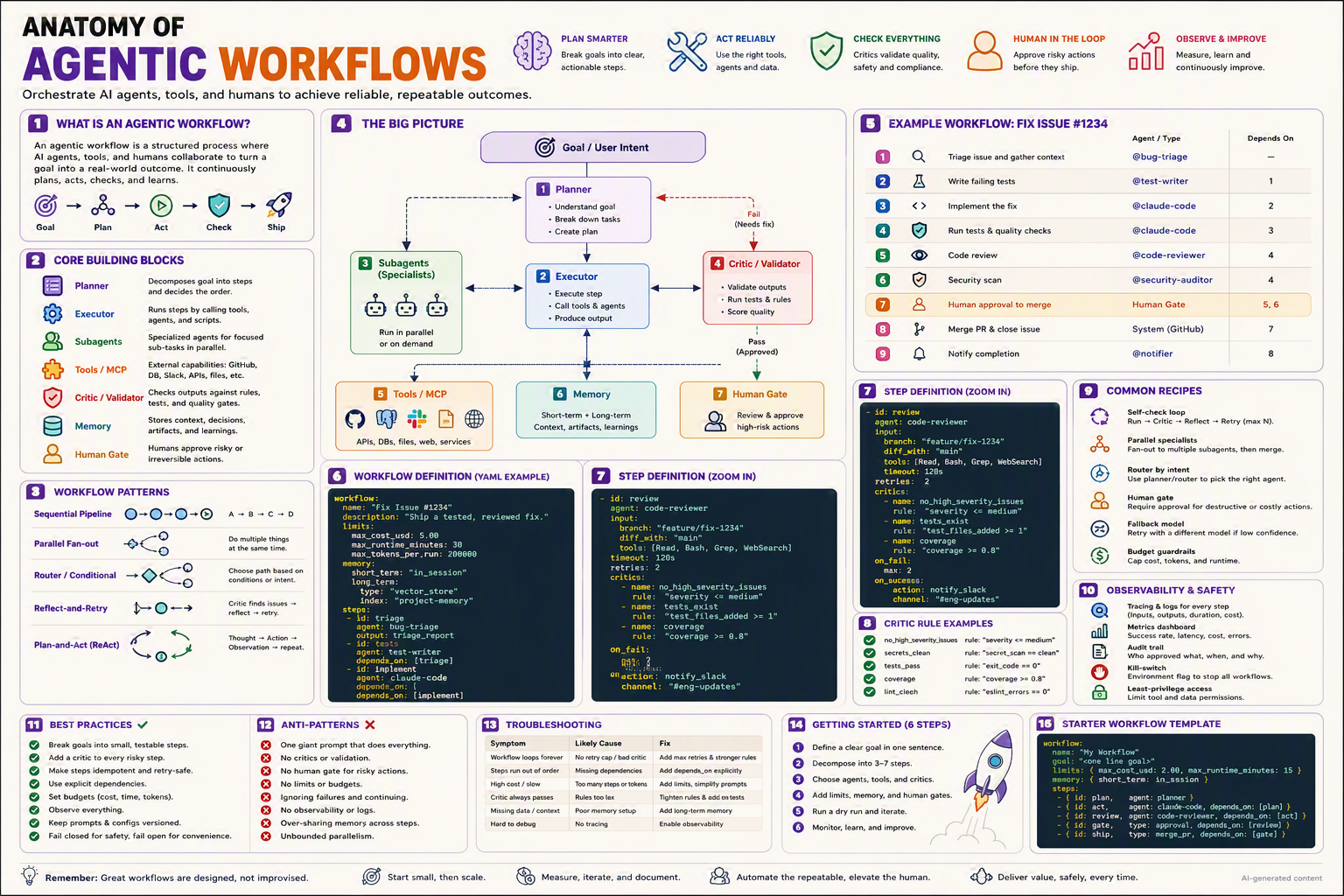
Orchestrating multiple AI agents, tools, and humans to ship real outcomes — reliably.
TL;DR
- An agentic workflow chains plans, tools, sub-agents, and humans to complete a goal.
- Core building blocks: Planner → Executor → Critic → Memory → Tools → Human Gate.
- Patterns: sequential, parallel fan-out, router, reflect-and-retry, plan-and-act.
- Add observability and kill-switches before scaling.
Why this matters
A single LLM call is a calculator. An agentic workflow is an assembly line — predictable, observable, and tunable. It's how AI moves from "demo" to "production".
Bottom line: The workflow, not the model, is the real product.
The Big Picture
Bottom line: Plan → act → check → (loop) → ship.
Core Roles
| Role | Purpose |
|---|---|
| Planner | Decomposes the goal into steps |
| Executor | Runs steps; calls tools |
| Critic / Validator | Checks each step's output |
| Memory | Short-term + long-term context |
| Tools / MCP | External capabilities |
| Subagents | Specialists for sub-tasks |
| Human Gate | Approval before risky actions |
Workflow Patterns
1. Sequential pipeline
goal → step1 → step2 → step3 → done
2. Parallel fan-out
            ┌─ analyze
goal ─ plan ┼─ test
            └─ document
3. Router (pick the right agent)
goal → router → @code-reviewer | @security-auditor | @docs-writer
4. Reflect-and-retry
attempt → critic → (fail) → reflect → retry → critic → done
5. Plan-and-act (ReAct)
Loop of Thought → Action → Observation until done.
Step-by-Step Setup
1. Define the goal in plain English
"Ship a tested, reviewed fix for issue #1234."
2. Decompose into a plan (plan.yml)
goal: "Fix issue #1234"
steps:
  - id: triage
    agent: bug-triage
    output: triage_report
  - id: tests
    agent: test-writer
    depends_on: [triage]
  - id: implement
    agent: claude-code
    depends_on: [tests]
  - id: review
    agent: code-reviewer
    depends_on: [implement]
  - id: human_gate
    type: approval
    depends_on: [review]
  - id: ship
    type: merge_pr
    depends_on: [human_gate]
3. Wire memory
"memory": {
  "short_term": { "type": "in_session" },
  "long_term":  { "type": "vector_store", "index": "project-memory" }
}
4. Add critics / validators
critics:
  - name: tests_pass
    rule: "exit_code == 0"
  - name: coverage
    rule: "coverage >= 0.8"
  - name: no_secrets
    rule: "secret_scan == clean"
5. Run & observe
claude workflow run plan.yml --observe
Variants for Different Team Settings
👤 Solo
Sequential, no human gate. Critic = your own eyes.
👥 Small team
Add a @code-reviewer critic + Slack notification on completion.
🏢 Enterprise
- Human gates on every risky step.
- Full audit trail to SIEM.
- Kill-switch env var (
CLAUDE_WORKFLOW_STOP=1). - Rate limits + budget caps.
limits:
  max_tokens_per_run: 200000
  max_cost_usd: 5.00
  max_runtime_minutes: 30
🌍 Open-source
- Publish workflows as templates in a community repo.
- Document expected inputs/outputs.
Bottom line: Same skeleton, escalating governance.
Anatomy of a Single Step
- id: review
  agent: code-reviewer
  input: { branch: feature/fix-1234 }
  tools: [Read, Bash, Grep]
  timeout: 120s
  retries: 2
  critics: [no_high_severity_issues]
  on_fail: rollback
  on_success: notify_slack
Common Patterns & Recipes
Pattern 1 — Self-check loop
- id: write_code
  agent: claude-code
- id: critique
  agent: code-reviewer
  on_fail: { goto: write_code, max: 3 }
Pattern 2 — Parallel subagents
- parallel:
    - { agent: security-auditor }
    - { agent: docs-writer }
    - { agent: test-writer }
Pattern 3 — Human-in-the-loop
- type: approval
  message: "Approve deploy to prod?"
  approvers: ["@milind", "@vamsi"]
Pattern 4 — Budget guardrail
limits: { max_cost_usd: 2.00 }
on_exceed: pause
Pattern 5 — Observability
"observability": {
  "trace": true,
  "metrics_endpoint": "https://otel.corp/v1/traces",
  "log_level": "info"
}
Best Practices ✅
- Decompose big goals into ≤ 7 steps.
- Add a critic to every risky step.
- Persist memory for multi-session work.
- Set budgets (tokens, $, time).
- Human gates before destructive actions.
- Observe everything (traces, metrics, logs).
- Idempotent steps — safe to retry.
Anti-Patterns ❌
- One giant prompt that "does everything".
- No critics — blind trust in LLM output.
- No budget caps — runaway costs.
- Skipping human gates on prod actions.
- Tightly coupled steps — hard to debug.
- No retries / error handling.
Troubleshooting
| Symptom | Cause | Fix |
|---|---|---|
| Workflow loops forever | No retry cap | Set max: on goto |
| Steps run out of order | Missing depends_on | Add explicit deps |
| Critic always passes | Rule too lax | Tighten rule + test |
| Costs spike | No budget | Add limits block |
| Hard to debug | No tracing | Enable OpenTelemetry |
| Race conditions | Shared mutable memory | Use scoped memory per step |
Starter Template
goal: "<one line>"
limits: { max_cost_usd: 2.00, max_runtime_minutes: 15 }
memory: { short_term: in_session }
steps:
  - { id: plan,    agent: planner }
  - { id: act,     agent: claude-code, depends_on: [plan] }
  - { id: review,  agent: code-reviewer, depends_on: [act] }
  - { id: gate,    type: approval, depends_on: [review] }
  - { id: ship,    type: merge_pr, depends_on: [gate] }
💡 Tip: Start with a 3-step linear workflow. Add parallelism only when you measure a bottleneck.
Glossary
- Agentic workflow — A multi-step process orchestrating agents, tools, and humans.
- Planner / Executor / Critic — The three core roles.
- ReAct — Reason + Act loop pattern.
- Human gate — Manual approval step.
- Memory — Short-term (session) and long-term (vector store) context.
- Kill-switch — A flag that halts all running workflows.
Further Reading
- Search: "agentic workflows patterns 2026"
- Search: "ReAct paper Yao et al."
- Search: "LLM orchestration LangGraph CrewAI AutoGen"
- Search: "AI workflow observability OpenTelemetry"