Anatomy of AI Incident Response Playbook
Runbooks, paging, mitigation, comms, war-room with AI copilots.
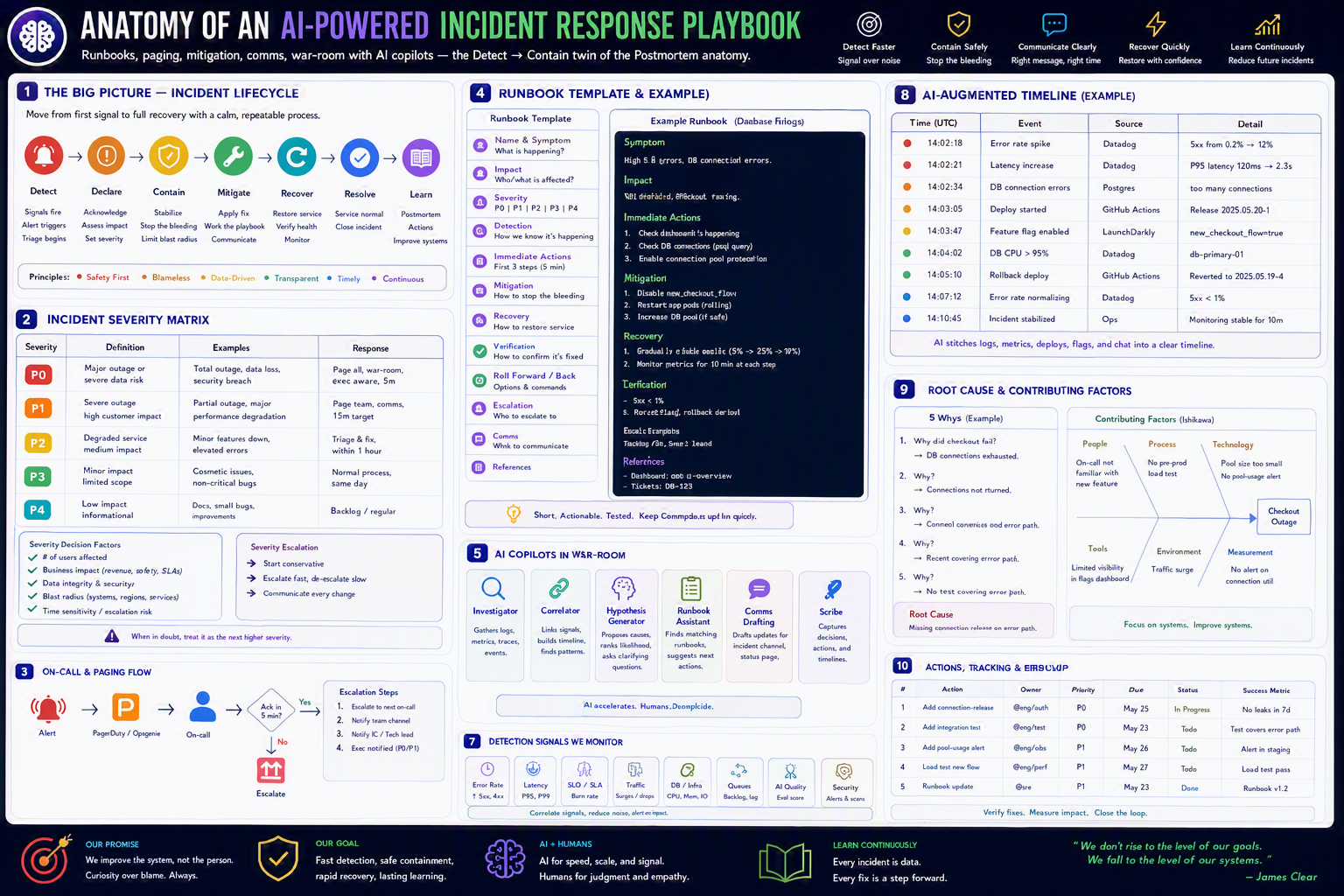
Runbooks, paging, mitigation, comms, war-room with AI copilots — the Detect → Contain → Recover twin of the Postmortem anatomy.
TL;DR
- An incident response playbook turns chaos into a calm, repeatable process.
- Seven phases: Detect → Declare → Contain → Mitigate → Recover → Resolve → Learn.
- Severity drives behavior — P0 pages everyone, P4 waits for backlog.
- AI copilots act as Investigator, Correlator, Hypothesis Generator, Runbook Assistant, Comms Drafter, and Scribe — not the decision-maker.
- Runbooks beat memory. Short, actionable, tested, kept up to date.
- Every incident closes with a blameless postmortem (see the Postmortem anatomy).
Why this matters
The first 15 minutes of an incident decide whether you're back in 30 minutes or 6 hours. Without a playbook you improvise, page the wrong people, miss the runbook, and the comms get worse than the outage. With one — and an AI copilot stitching signals together — your team detects faster, contains safely, recovers quickly, and learns continuously.
Bottom line: We improve the system, not the person. Curiosity over blame. Always.
The Big Picture — Incident Lifecycle
Principles
- 🛡️ Safety first
- 🤝 Blameless
- 📊 Data-driven
- 🪟 Transparent
- ⏱️ Timely
- ♻️ Continuous
Bottom line: Move from first signal to full recovery with a calm, repeatable process — every time.
Incident Severity Matrix
Severity drives who, when, and how loud. Define it once, apply it consistently.
| Severity | Definition | Examples | Response |
|---|---|---|---|
| 🔴 P0 | Major outage or severe data/security risk | Total outage, data loss, security breach | Page all, war-room, exec aware, 5 m |
| 🟠 P1 | Severe outage, high customer impact | Partial outage, major performance degradation | Page team, comms, 15 m target |
| 🟡 P2 | Degraded service, medium impact | Minor features down, elevated errors | Triage & fix, within 1 hour |
| 🟢 P3 | Minor impact, limited scope | Cosmetic issues, non-critical bugs | Normal process, same day |
| 🔵 P4 | Low impact, informational | Docs, small bugs, improvements | Backlog / regular |
Severity decision factors
- 👥 # of users affected
- 💰 Business impact (revenue, safety, SLAs)
- 🔐 Data integrity & security
- 🌐 Blast radius (systems, regions, services)
- ⏱️ Time sensitivity / escalation risk
Escalation rule of thumb
- 🚀 Start conservative (declare higher).
- ⚡ Escalate fast, de-escalate slow.
- 📢 Communicate every change in severity.
⚠️ When in doubt, treat it as the next higher severity.
On-Call & Paging Flow
Escalation steps
- Escalate to next on-call
- Notify team channel
- Notify IC / Tech lead
- Exec notified (P0/P1)
Paging policy (starter)
- P0: Primary on-call + secondary + tech lead + incident commander (IC).
- P1: Primary on-call + team channel + tech lead.
- P2: Primary on-call + team channel.
- P3/P4: Team channel only.
💡 Tip: Codify this in PagerDuty/Opsgenie escalation policies; do not rely on memory.
Runbook Template & Example
A great runbook is short, actionable, tested, and kept up to date.
Runbook template
# Runbook: <symptom>

## Name & Symptom
What is happening? (one line)

## Impact
Who / what is affected, severity, business impact.

## Severity
P0 | P1 | P2 | P3 | P4

## Detection
How we know it's happening (alerts, dashboards).

## Immediate Actions
First 3 steps (5 minutes).

## Mitigation
How to stop the bleeding.

## Recovery
How to restore service.

## Verification
How to confirm it's fixed.

## Roll Forward / Back
Options & commands.

## Escalation
Who to escalate to, when.

## Comms
What to communicate, where, how often.

## References
Dashboards · PRs · tickets · related runbooks.
Example runbook — "Database errors"
# Symptom
High 5xx errors, DB connection errors.

## Impact
~50% of checkout users impacted; ~$5k/min revenue loss.

## Severity
P1

## Detection
- Datadog: error_rate > 5% for 2m
- Postgres: "too many connections" in logs

## Immediate Actions (first 5 min)
1. Check dashboard: ai-overview
2. Check DB connections: `psql -c "select count(*) from pg_stat_activity;"`
3. Enable connection pool protection.

## Mitigation
1. Disable `new_checkout_flow` flag (LaunchDarkly).
2. Restart app pods (rolling).
3. Increase DB pool size (if safe; cap at 200).

## Recovery
1. Gradually re-enable flag: 5% → 25% → 100%.
2. Monitor metrics for 10 min at each step.

## Verification
- 5xx < 1%
- P95 latency < 500 ms
- No new errors in app logs

## Escalation
Page @sre lead after 15 min if not mitigated.

## References
- Dashboard: ai-overview
- Tickets: DB-123, INC-2025-05-20
💡 Tip: Short. Actionable. Tested. Keep commands up to date.
AI Copilots in the War-Room
AI is your force multiplier during an incident — for speed, scale, and signal. Humans own judgment and empathy.
| Copilot | Role | What it does |
|---|---|---|
| 🔬 Investigator | Evidence gatherer | Pulls logs, metrics, traces, events |
| 🔗 Correlator | Pattern finder | Links signals; builds timeline; finds patterns |
| 💡 Hypothesis Generator | Likely-cause proposer | Ranks likelihood; asks clarifying questions |
| 📒 Runbook Assistant | Right-runbook router | Finds matching runbooks; suggests next actions |
| 💬 Comms Drafting | Update writer | Drafts updates for incident channel, status page |
| 🖊️ Scribe | Memory keeper | Captures decisions, actions, timeline events |
Sample war-room AI commands
/incident start <severity> <symptom>
/timeline                              — show evolving timeline
/hypotheses                            — top 5 likely causes with evidence
/runbook <symptom>                     — find matching runbook
/comms draft <internal|status-page>    — draft update text
/scribe note <decision>                — record a decision in the ledger
/postmortem draft                      — auto-draft after resolution
💡 Tip: AI accelerates. Humans decide. Every AI suggestion must be reviewable, with sources.
Detection Signals We Monitor
Correlate signals to reduce noise, alert on impact.
| Signal | Why it matters |
|---|---|
| ❌ Error rate (↑ 5xx, 4xx) | Most direct user-pain proxy |
| ⏱️ Latency (P95, P99) | UX & timeout cliffs |
| 🎯 SLO / SLA burn rate | Compliance & promises |
| 🚦 Traffic (surges / drops) | Capacity / outage hints |
| 🗄️ DB / infra (CPU, mem, I/O) | Resource exhaustion |
| 📨 Queues (backlog, lag) | Pipeline health |
| ⭐ AI quality (eval score) | Silent quality drift |
| 🛡️ Security (alerts, scans) | Breach indicators |
💡 Tip: Pair every alert with a runbook link in the alert itself.
AI-Augmented Timeline (example)
| Time (UTC) | Event | Source | Detail |
|---|---|---|---|
| 🔴 14:02:18 | Error rate spike | Datadog | 5xx from 0.2% → 12% |
| 🟡 14:02:21 | Latency increase | Datadog | P95 latency 120ms → 2.3s |
| 🔴 14:02:34 | DB connection errors | Postgres | "too many connections" |
| 🔵 14:03:05 | Deploy started | GitHub Actions | Release 2025.05.20-1 |
| 🟠 14:03:47 | Feature flag enabled | LaunchDarkly | new_checkout_flow=true |
| 🟣 14:04:02 | DB CPU > 95% | Datadog | db-primary-01 |
| 🟢 14:05:10 | Rollback deploy | GitHub Actions | Reverted to 2025.05.19-4 |
| 🟢 14:07:12 | Error rate normalizing | Datadog | 5xx < 1% |
| 🟢 14:10:45 | Incident stabilized | Ops | Monitoring stable for 10 m |
💡 Tip: AI stitches logs, metrics, deploys, flags, and chat into a clear shared timeline — within seconds.
Root Cause & Contributing Factors (preview)
The handoff to the postmortem starts during the incident.
5 Whys (example)
1. Why did checkout fail?      → DB connections exhausted.
2. Why?                         → Connections not returned.
3. Why?                         → Code missed release on error path.
4. Why?                         → Recent change covered error path poorly.
5. Why?                         → No test covering error path.
→ Root cause: missing connection release on error path.
Contributing factors (Ishikawa)
- People: On-call not familiar with new feature.
- Process: No pre-prod load test.
- Technology: Pool size too small; no pool-usage alert.
- Environment: Traffic surge.
- Tools: Limited visibility in flags dashboard.
- Measurement: No alert on connection utilization.
Focus on systems. Improve systems. (Full treatment lives in the Postmortem anatomy.)
Actions, Tracking & Closeup
Every incident closes with specific, owned, time-bound actions.
| # | Action | Owner | Priority | Due | Status | Success metric |
|---|---|---|---|---|---|---|
| 1 | Add connection-release | @eng/auth | P0 | May 25 | In progress | No leaks in 7d |
| 2 | Add integration test | @eng/test | P0 | May 23 | Todo | Test covers error path |
| 3 | Add pool-usage alert | @eng/obs | P1 | May 26 | Todo | Alert fires in staging |
| 4 | Load test new flow | @eng/perf | P1 | May 27 | Todo | Load test passes |
| 5 | Runbook update | @sre | P1 | May 23 | Done | Runbook v1.2 |
💡 Tip: Verify fixes. Measure impact. Close the loop.
Communications Templates
Internal — incident channel (first 5 minutes)
🚨 INCIDENT DECLARED — P1
Title: <one-line symptom>
Started: <time UTC>
Impact: <users / business>
IC: @ic   Tech Lead: @tl   Comms: @comms
Runbook: <link>
Channel: #inc-2025-05-20-checkout-5xx
Status page — public-facing (concise, empathic)
Investigating — Some users may experience errors when checking out.
We're investigating and will share an update by HH:MM UTC.
Update cadence (defaults)
- P0/P1: Every 15 minutes until mitigated; then every 30 minutes.
- P2: Every hour.
- P3/P4: On status change.
Resolution note
Resolved — At HH:MM UTC, we restored service.
Cause: <plain-language summary>.
Customer impact: <numbers>.
Next steps: We'll publish a postmortem within 5 business days.
💡 Tip: Right message, right time. Be honest, specific, and brief.
Roles in the War-Room
| Role | Job in 1 line |
|---|---|
| 🎙️ Incident Commander (IC) | Owns the response; drives decisions. |
| 🧠 Tech Lead (TL) | Owns technical strategy & fix. |
| 💬 Communications Lead | Owns internal + external updates. |
| 📝 Scribe | Owns the timeline + decisions ledger. |
| 🛠️ Responders | Execute the runbook; report findings. |
| 🤝 Liaison(s) | Support, legal, exec, key customers. |
💡 Tip: One person, one role. The IC does not type fixes.
Step-by-Step Setup
1. Define severity & paging policy
- Write a one-page
docs/incident-severity.md. - Codify P0–P4 in PagerDuty/Opsgenie escalation policies.
2. Create the runbook library
runbooks/_template.md(from above).- Convert each top alert into a runbook; link it in the alert payload.
3. Ship the AI copilots
Create slash commands:
.claude/commands/incident.md— start, status, comms.claude/commands/runbook.md— find runbook by symptom.claude/commands/timeline.md— reconstruct timeline.claude/commands/comms.md— draft updates
4. Add a @incident-commander subagent
name: incident-commander
description: Coordinates incident response with calm, decisive prompts.
model: claude-sonnet-4
tools: [Read, WebSearch, Bash, Grep]
permissions:
  allow: ["Read", "WebSearch"]
  deny:  ["Write", "Bash(rm -rf *)"]
system_prompt: |
  You are an Incident Commander.
  Be calm, concrete, and time-aware.
  Always cite sources. Distinguish facts from hypotheses.
  Drive decisions; surface tradeoffs; never assign blame.
triggers: ["incident", "outage", "P0", "P1"]
5. Wire data sources via MCP
GitHub Actions, PagerDuty/Opsgenie, Datadog/Sentry, LaunchDarkly, Slack/Teams.
6. Drill it
- Quarterly chaos / game-day exercises.
- After each drill, update runbooks and policies.
7. Close the loop
After every P0/P1: a blameless postmortem (see the Postmortem anatomy).
Variants for Different Team Settings
👤 Solo developer
- Severities: just P1 / P3.
- One runbook file with a section per symptom.
- "War-room" = a tmux window +
/incidentcommand.
👥 Small team (2–10)
- Severities: P0–P3.
- One incident channel per outage; pinned ledger.
- IC rotation; weekly runbook review.
🏢 Enterprise / regulated
- Full IC role; comms lead; legal/compliance liaison.
- Status page + customer comms templates approved by Legal.
- Audit trail (immutable storage; signed actions).
- Major incidents → exec briefing within 30 min.
🌍 Open-source / community
- Public status page; transparent updates.
- Community responders welcomed; clear contributor guidelines.
- Coordinated disclosure for security incidents.
Bottom line: Same lifecycle, escalating governance.
Anatomy of the First 15 Minutes (zoom-in)
00:00  Alert fires (PagerDuty)
00:01  On-call acks; opens #inc-2025-05-20-checkout-5xx
00:02  /incident start P1 "checkout 5xx spike"
00:03  AI investigator pulls dashboards, latest deploys, flag flips
00:05  IC assigned; tech lead joins; comms lead joins
00:07  /runbook "checkout 5xx" → "Database errors" runbook surfaced
00:08  Mitigation step 1: disable feature flag (LaunchDarkly)
00:10  Error rate falling; status page update posted
00:13  Mitigation step 2: rolling restart of app pods
00:15  Stabilization confirmed; monitoring window begins
💡 Tip: Most incidents are won or lost in the first 15 minutes. Practice them.
Common Patterns & Recipes
Pattern 1 — One-command war-room
/incident start P1 "<symptom>"
Creates the channel, pages roles, opens a ledger, starts the timeline.
Pattern 2 — AI-suggested next action
Given current state, propose the top 3 next mitigation steps,
ranked by expected impact and risk, with sources.
Pattern 3 — Status-page draft
Draft a status-page update in 50 words.
Be empathic; commit to a next update in 15 min.
Pattern 4 — Hypothesis tree
Build a hypothesis tree for "<symptom>" with:
- evidence for/against
- ranked probability
- cheapest disproving experiment
Pattern 5 — Action SMART check
Critique each action item: Specific, Measurable, Assigned, Realistic, Time-bound.
Pattern 6 — Multi-source merge
Merge today's deploys, flag changes, and error spikes into a single
deduped timeline. Cite each row.
Pattern 7 — Cross-incident pattern detection
Across the last 10 incidents, list:
- top 3 recurring symptoms
- top 3 systemic gaps
- proposed program-level initiatives
Best Practices ✅
- 🛡️ Severity drives behavior. Define it; honor it.
- 🧷 Pair every alert with a runbook link in the payload.
- 🆔 Use shared
trace_ids across logs, metrics, and chat. - 📝 Scribe in real time — decisions and timestamps.
- 🧪 Practice with game days quarterly.
- 🤖 Let AI accelerate, never decide.
- 🪞 Close the loop with a blameless postmortem.
Anti-Patterns ❌
- 🚫 Skipping severity ("we'll figure it out").
- 🚫 One channel for everything (incident noise drowns signal).
- 🚫 Trusting AI hypotheses without verification.
- 🚫 Blaming individuals.
- 🚫 No runbooks, or stale runbooks.
- 🚫 Status-page silence.
- 🚫 No drills.
Troubleshooting
| Symptom | Likely cause | Fix |
|---|---|---|
| Slow detection | Noisy alerts | Reduce, refine, add severity-based routing |
| Long mitigation | No runbook | Convert top 5 alerts into runbooks this week |
| Comms chaos | No comms lead role | Assign one; use templates |
| Same incident repeats | Postmortem actions not shipped | Monthly action-review meeting |
| AI hallucinates causes | Ungrounded prompts | Force "cite source" in subagent prompts |
| Confusion over severity | No matrix | Adopt the severity matrix above |
| Drills fail | Untested runbooks | Quarterly game days + update runbooks |
Quick-Start Checklist
- ✅ Severity matrix documented and adopted
- ✅ Paging policy codified in PagerDuty/Opsgenie
- ✅
runbooks/library seeded for top 5 alerts - ✅
/incident,/runbook,/timeline,/commsslash commands - ✅
@incident-commandersubagent shipped - ✅ Status-page templates approved
- ✅ Quarterly game-day on the calendar
- ✅ Postmortem template + auto-draft wired
🧠 Mantra: Detect faster · Contain safely · Communicate clearly · Recover quickly · Learn continuously.
Starter Configs
.claude/commands/incident.md
---
description: Start, status, or close an incident
usage: /incident <start|status|close> [--sev <P0|P1|P2|P3|P4>] [--title "<symptom>"]
permissions:
  allow: ["Read", "WebSearch", "MCP:datadog", "MCP:github", "MCP:slack", "MCP:pagerduty"]
  deny:  ["Write"]
---
You are an Incident Commander assistant. Do exactly what the user asks.

If `start`:
1. Open a channel: `#inc-YYYY-MM-DD-<slug>`
2. Page roles by severity (P0/P1: IC + TL + Comms).
3. Open a ledger in `docs/incidents/<id>.md` with the template.
4. Build the initial timeline from observability + deploys + flags.

If `status`:
- Summarize current state in 5 lines.
- List open mitigation actions and owners.
- Suggest next update message + cadence.

If `close`:
- Verify recovery against runbook checklist.
- Generate the postmortem draft seed.
runbooks/_template.md
# Runbook: <symptom>

## Name & Symptom
## Impact
## Severity
## Detection
## Immediate Actions
## Mitigation
## Recovery
## Verification
## Roll Forward / Back
## Escalation
## Comms
## References
.claude/commands/comms.md
---
description: Draft an incident communication
usage: /comms draft <internal|status-page|exec> [--minutes <n>]
---
Write a {{internal|status-page|exec}} update for the current incident.
Tone: clear, honest, empathetic.
Constraints: ≤ 80 words; specific impact; next update in {{minutes=15}} min.
End with a commitment to the next update.
Glossary
- Incident Commander (IC) — Owns the response; drives decisions.
- Tech Lead (TL) — Owns the technical strategy and fix.
- Severity (P0–P4) — Standardized incident impact tier.
- Runbook — Step-by-step response for a known symptom.
- Mitigation — Action that reduces or stops impact (not yet a full fix).
- Recovery — Restoring full service.
- Resolution — Confirmed recovery + incident closed.
- MTTD / MTTR — Mean Time to Detect / Resolve.
- Blast radius — Scope of users / systems affected.
- Status page — Public-facing service health portal.
Further Reading
- Search: "Google SRE incident management workbook"
- Search: "PagerDuty incident response guide"
- Search: "chaos engineering game days"
- Search: "AI copilots for SRE incident response"
🪙 Promise, Goal, Approach
- 🤝 Our promise: We improve the system, not the person. Curiosity over blame. Always.
- 🎯 Our goal: Fast detection, safe containment, rapid recovery, lasting learning.
- 🤖 AI + humans: AI for speed, scale, and signal. Humans for judgment and empathy.
- ♻️ Learn continuously: Every incident is data. Every fix is a step forward.
"We don't rise to the level of our goals. We fall to the level of our systems." — James Clear