Anatomy of AI Cost & Token Economics
Models, context, batching, caching, and cost guardrails.
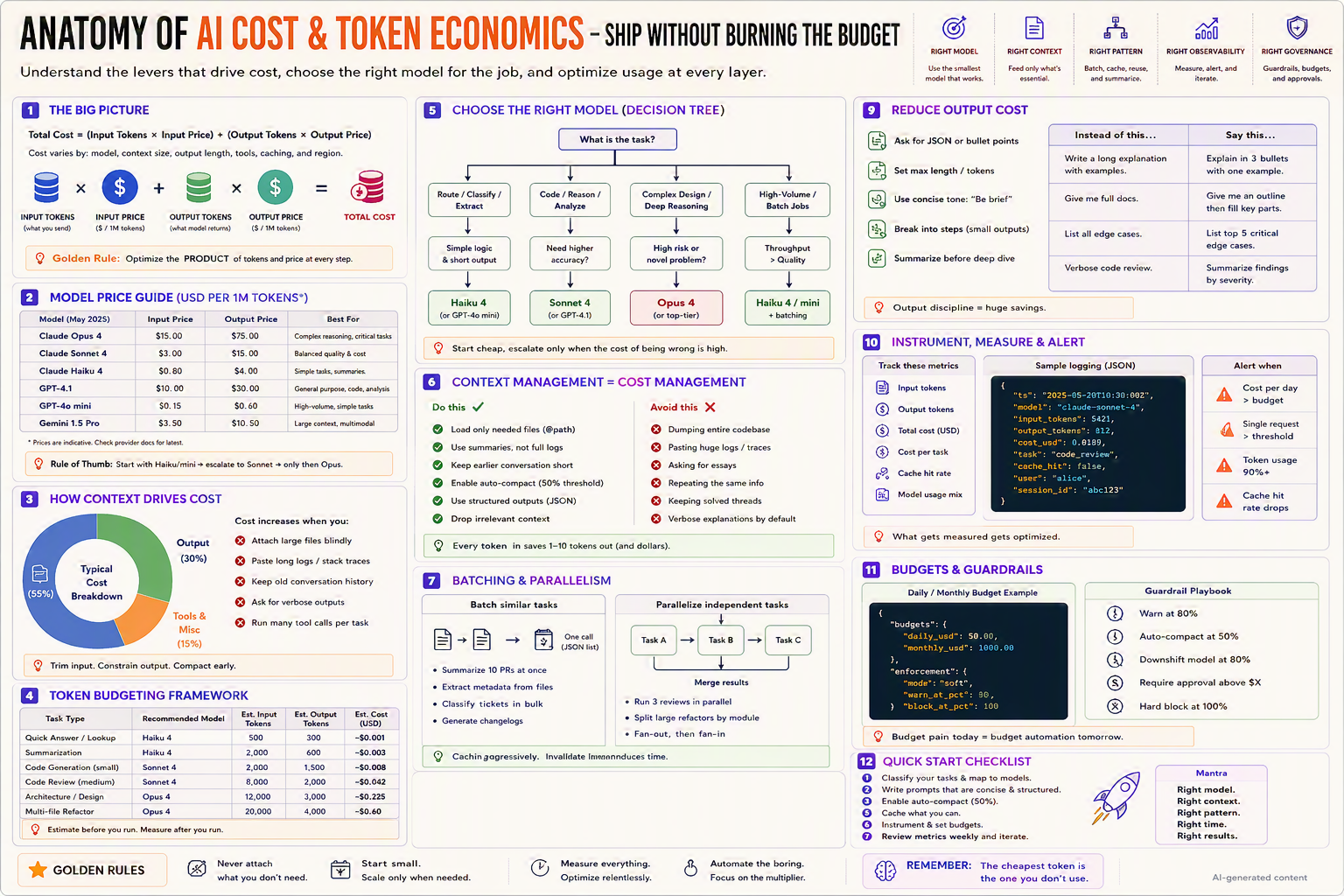
How to ship without burning the budget — pick the right model, feed the right context, batch & cache aggressively, and measure relentlessly.
TL;DR
- Total cost =
(input tokens × input price) + (output tokens × output price)— every layer scales with this formula. - The biggest savings come from less context and shorter outputs, not just cheaper models.
- Tier your models: Haiku for routing & summaries, Sonnet for everyday code, Opus only when accuracy really matters.
- Batch · cache · stream · parallelize — four levers that compound.
- Instrument first. What you don't measure, you can't reduce.
Why this matters
LLM costs scale with use, not seats. A team that ships 50 PRs/week with AI assistance can easily 10× its bill in a month if no one is watching the meter. The fix isn't to use less AI — it's to use AI deliberately.
Bottom line: Token discipline is the difference between a $200/mo magic teammate and a $20,000/mo budget surprise.
The Big Picture — The Cost Formula
Total Cost = (Input Tokens × Input Price)
           + (Output Tokens × Output Price)
Cost varies by:
- 🧠 Model (Haiku < Sonnet < Opus)
- 📦 Context size (every token you send)
- 📝 Output length (often the bigger half!)
- 🛠️ Tool calls (each round-trip = more tokens)
- 💾 Caching (huge multiplier when reused)
- 🌍 Region / provider
🪙 Golden rule: Optimize the product of tokens × price at every step.
Model Price Guide (USD per 1M tokens)
💡 Prices are indicative and change frequently. Always confirm with the provider's pricing page before locking in a budget.
| Model (as of mid-2025) | Input | Output | Best for |
|---|---|---|---|
| Claude Opus 4 | $15.00 | $75.00 | Complex reasoning, critical tasks |
| Claude Sonnet 4 | $3.00 | $15.00 | Balanced quality & cost ⭐ |
| Claude Haiku 4 | $0.80 | $4.00 | Simple tasks, summaries, routing |
| GPT-4.1 | $10.00 | $30.00 | General-purpose, code, analysis |
| GPT-4o mini | $0.15 | $0.60 | High-volume, simple tasks |
| Gemini 1.5 Pro | $3.50 | $10.50 | Large context, multimodal |
💡 Rule of thumb: Start with Haiku/mini → escalate to Sonnet → only then Opus.
How Context Drives Cost
Typical cost breakdown for a medium coding session:
| Source | % of cost | Why |
|---|---|---|
| Context (input) | ~55% | Files, history, system prompts |
| Output (generation) | ~30% | Responses, code, explanations |
| Tools & misc | ~15% | Tool calls, retries, overhead |
Costs spike when you:
- ❌ Attach large files blindly
- ❌ Paste long logs / stack traces
- ❌ Keep old conversation history forever
- ❌ Ask for verbose outputs ("explain everything")
- ❌ Run many tool calls per task
💡 Tip: Trim input. Constrain output. Compact early.
Token Budgeting Framework
Estimate before you run. Measure after you run. Refine.
| Task type | Recommended model | Est. input tokens | Est. output tokens | Est. cost (USD) |
|---|---|---|---|---|
| Quick answer / lookup | Haiku 4 | 500 | 300 | ~$0.001 |
| Summarization | Haiku 4 | 2,000 | 600 | ~$0.003 |
| Code generation (small) | Sonnet 4 | 2,000 | 1,500 | ~$0.028 |
| Code review (medium) | Sonnet 4 | 8,000 | 2,000 | ~$0.054 |
| Architecture / design | Opus 4 | 12,000 | 3,000 | ~$0.405 |
| Multi-file refactor | Opus 4 | 20,000 | 4,000 | ~$0.600 |
💡 Tip: Multiply expected daily runs to forecast monthly burn. A 200× factor between Haiku and Opus is normal.
Choose the Right Model — Decision Tree
💡 Tip: Start cheap. Escalate only when the cost of being wrong is high.
Context Management = Cost Management
✅ Do this
- Load only needed files (
@path/to/file). - Use summaries, not full logs.
- Keep earlier conversation short.
- Enable auto-compact (50% threshold).
- Use structured outputs (JSON) — fewer wasted tokens.
- Drop irrelevant context between turns.
❌ Avoid
- ❌ Dumping entire codebases
- ❌ Pasting huge logs / traces
- ❌ Asking for essays when bullets do
- ❌ Repeating the same info
- ❌ Keeping solved threads alive
- ❌ Verbose explanations by default
💡 Tip: Every token in saves 1–10 tokens out (and dollars).
Batching & Parallelism
Batch similar tasks
Summarize 10 PRs at once → one call → return JSON list
Extract metadata from files → one prompt, batched files
Classify tickets in bulk → one prompt, many inputs
Generate changelogs → one prompt, multiple commits
Why it wins: shared system prompt + amortized overhead across N tasks.
Parallelize independent tasks
Wins on wall-clock time (faster sessions, smaller context per agent).
Cache aggressively
- Prompt caching: Reuse identical system prompts at fraction price.
- Embedding caching: Don't re-embed unchanged docs.
- Tool-output caching: Cache deterministic tool results.
- Invalidate when underlying data actually changes.
💡 Tip: A 90%+ cache hit rate on system prompts is achievable and pays for itself in days.
Reduce Output Cost (often the bigger half)
| Instead of this… | …say this |
|---|---|
| "Write a long explanation with examples." | "Explain in 3 bullets with one example." |
| "Give me full docs." | "Give me an outline then fill key parts." |
| "List all edge cases." | "List top 5 critical edge cases." |
| "Verbose code review." | "Summarize findings by severity." |
Output-shaping tactics
- 📋 Ask for JSON or bullet points.
- 🪶 Set
max_tokens/max_length. - ✂️ Use a concise tone: "Be brief."
- 🪜 Break into steps with small outputs each.
- 🧪 Summarize before deep dives.
💡 Tip: Output discipline = huge savings. Often 30–60% off a bill.
Instrument, Measure & Alert
Track these metrics
| Metric | Why it matters |
|---|---|
| Input tokens | Detect bloated prompts |
| Output tokens | Detect verbose responses |
| Total cost (USD) | The bottom line |
| Cost per task | Right-size your unit economics |
| Cache hit rate | Caching effectiveness |
| Model usage mix | Are you over-using premium tiers? |
Sample logging payload
{
  "ts": "2025-05-20T10:30:00Z",
  "model": "claude-sonnet-4",
  "input_tokens": 5421,
  "output_tokens": 812,
  "cost_usd": 0.0189,
  "task": "code_review",
  "cache_hit": false,
  "user": "alice",
  "session_id": "abc123"
}
Alert when
- 🚨 Cost per day > budget
- 🚨 Single request > threshold (e.g., $1)
- 🚨 Token usage > 90% of context window
- 🚨 Cache hit rate drops suddenly (regression)
💡 Tip: What gets measured gets optimized. Send these to your existing dashboard (Datadog, Grafana, etc.).
Budgets & Guardrails
Daily / monthly budget config
{
  "budgets": {
    "daily_usd": 50.00,
    "monthly_usd": 1000.00
  },
  "enforcement": {
    "mode": "soft",            // soft | hard
    "warn_at_pct": 80,
    "block_at_pct": 100
  }
}
Guardrail playbook
| Threshold | Action |
|---|---|
| 80% of budget | Warn user + team channel |
| 50% context used | Auto-compact |
| 80% context used | Downshift to cheaper model |
| Request > $X | Require human approval |
| 100% budget | Hard block + escalation |
💡 Tip: Budget pain today = budget automation tomorrow. Codify thresholds early.
Step-by-Step Setup
1. Classify your tasks and map to models
Create docs/model-routing.md:
| Task | Model | Why |
|---|---|---|
| Triage / routing | Haiku | Cheap, fast, simple |
| Code review | Sonnet | Balanced quality/cost |
| Critical refactor | Opus | Accuracy worth the cost |
2. Enable auto-compact in .claude/settings.json
{
  "env": { "CLAUDE_AUTOCOMPACT_PCT_OVERRIDE": "50" },
  "features": {
    "autoCompact": true,
    "autoCompactMode": "balanced"
  }
}
3. Add a cost-logging hook
scripts/log-cost.sh:
#!/usr/bin/env bash
# Append per-call metrics to a daily file
DATE=$(date +%Y-%m-%d)
mkdir -p .claude/logs
echo "{\"ts\":\"$(date -Iseconds)\",\"model\":\"$CLAUDE_MODEL\",\"in\":$CLAUDE_INPUT_TOKENS,\"out\":$CLAUDE_OUTPUT_TOKENS,\"cost\":$CLAUDE_COST_USD}" \
  >> ".claude/logs/cost-$DATE.jsonl"
.claude/settings.json:
"hooks": {
  "PostToolUse": [
    { "matcher": "*",
      "hooks": [{ "type": "command", "command": "./scripts/log-cost.sh" }] }
  ]
}
4. Add a /budget slash command
.claude/commands/budget.md:
---
description: Show today's spend, top tasks, cache hit rate
usage: /budget [--month]
---
Read `.claude/logs/cost-*.jsonl` and report:
- Spend today vs daily budget (with % bar)
- Top 5 costliest tasks
- Model usage mix
- Cache hit rate
- Suggestion: any task to downshift?
5. Start cheap, escalate deliberately
Default model = Sonnet. Switch to Opus only via explicit /escalate command.
6. Review weekly
Weekly retro: which tasks blew the budget? Re-route them.
Variants for Different Team Settings
👤 Solo developer
- Default to Haiku for everything except complex refactors.
- One JSON log, one weekly glance.
- Budget: $20–50/mo typical.
👥 Small team (2–10)
- Shared
model-routing.md. - Per-user daily soft-cap, team monthly hard-cap.
- Slack alert at 80%.
- Cache shared system prompts repo-wide.
🏢 Enterprise / regulated
- Hard budgets per project.
- Cost attribution by team/cost-center via metadata in every call.
- Approval workflow for Opus / large-context requests.
- Centralized FinOps dashboard.
- Quarterly model re-tiering as prices change.
🌍 Open-source / community
- Cap per-contributor session to prevent abuse.
- Document recommended models in
CONTRIBUTING.md. - Provide a free-tier-friendly default config.
Bottom line: Same formula, escalating discipline.
Common Patterns & Recipes
Pattern 1 — Two-pass cheap-then-deep
Pass 1 (Haiku): classify and triage the diff.
Pass 2 (Sonnet): only deep-review files flagged risky.
Pattern 2 — Summarize-then-act
Step 1: Summarize the 20 files into a 200-line plan.
Step 2: Hand only the plan + 3 files to Opus.
Pattern 3 — Hierarchical routing
router:
  default: haiku
  if_keyword: ["refactor", "architecture", "design"] → opus
  if_size > 5000_tokens → sonnet
Pattern 4 — Cached system prompt
Reuse identical "You are a senior reviewer..." block.
Cache hit = ~10× cheaper input tokens.
Pattern 5 — Budget-aware retry
On model error or timeout:
  - First retry: same model
  - Second retry: downshift one tier
  - Then: surface to human
Pattern 6 — JSON-mode for parsability
Return ONLY this JSON:
{ "summary": "...", "issues": [...], "fixes": [...] }
Outputs shrink ~30% and your code can parse without LLM glue.
Best Practices ✅
- Use the smallest model that works.
- Feed only what's essential.
- Batch, cache, reuse, summarize.
- Measure, alert, iterate.
- Codify budgets & approvals.
- Right-tier weekly as prices and quality evolve.
- Document model routing so the team makes the same call.
Anti-Patterns ❌
- 🚫 Defaulting to Opus "to be safe".
- 🚫 Pasting entire codebases into context.
- 🚫 Asking for verbose explanations by default.
- 🚫 No caching of system prompts.
- 🚫 No metrics, no budgets, no alerts.
- 🚫 Treating context length as free.
- 🚫 Hardcoding model names in every script (impossible to retier).
Troubleshooting
| Symptom | Likely cause | Fix |
|---|---|---|
| Sudden cost spike | New chatty prompt / large file attached | Audit recent diffs to prompts |
| Slow + expensive | Wrong tier (Opus on simple tasks) | Add router rule, downshift |
| Cache hit rate drops | Prompt changed slightly each call | Stabilize boilerplate; parameterize variants |
| Output too long | No format / max_tokens | Enforce JSON or bullets + cap |
| Token usage > 90% | Context bloat | Enable auto-compact (50%) |
| One user dominates spend | No per-user budget | Per-seat soft caps + Slack alert |
| Repeated tool errors | Retries on premium model | Budget-aware retry + downshift |
Quick-Start Checklist
- ✅ Classify tasks and map them to models.
- ✅ Write prompts that are concise & structured.
- ✅ Enable auto-compact (50%).
- ✅ Cache what you can (system prompts, embeddings, tool outputs).
- ✅ Instrument & set budgets (daily + monthly).
- ✅ Review metrics weekly and iterate.
🧠 Mantra: Right model. Right context. Right pattern. Right time. Right results.
Starter Configs
.claude/settings.json — cost-savvy defaults
{
  "model": {
    "default": "claude-sonnet-4",
    "fallback": ["claude-haiku-4"]
  },
  "env": {
    "MAX_THINKING_TOKENS": "60000",
    "CLAUDE_AUTOCOMPACT_PCT_OVERRIDE": "50"
  },
  "features": {
    "autoCompact": true,
    "autoCompactMode": "balanced"
  },
  "hooks": {
    "PostToolUse": [
      { "matcher": "*",
        "hooks": [{ "type": "command", "command": "./scripts/log-cost.sh" }] }
    ]
  }
}
model-routing.md — your team's rule book
# Model Routing

| Task                | Model    | Rationale            |
|---------------------|----------|----------------------|
| Routing / classify  | Haiku    | Cheap, fast          |
| Summarization       | Haiku    | Output is short      |
| Daily code work     | Sonnet   | Balanced             |
| Architecture        | Opus     | Accuracy matters     |
| Bulk transforms     | Haiku    | Batch + parallelize  |

## Escalation
Use `/escalate` to bump the next tier with a 1-line reason
(logged for the weekly review).
Glossary
- Token — Roughly ~4 characters of text; the LLM's unit of work and cost.
- Context window — Max tokens the model can "see" per call.
- Input tokens — What you send (prompt + system + history + tools).
- Output tokens — What the model returns. Often 5× the price of input.
- Prompt caching — Reusing identical prompt prefixes at a discount.
- Auto-compact — Automatic summarization to keep context lean.
- Routing / tiering — Picking the cheapest model that meets the bar.
- Batching — Combining many tasks into one call.
- FinOps — Discipline of managing cloud / AI costs.
Further Reading
- Search: "Anthropic prompt caching docs"
- Search: "OpenAI pricing & batch API"
- Search: "LLM cost optimization patterns 2026"
- Search: "FinOps for AI workloads"
🪙 Golden Rules
- 🛑 Never attach what you don't need.
- 🌱 Start small. Scale only when needed.
- 📊 Measure everything. Optimize relentlessly.
- 🤖 Automate the boring. Focus on the multiplier.
Remember: The cheapest token is the one you don't use.